5 Strategies for Cloud Cost Optimization
Uncontrolled cloud spending rapidly erodes engineering margins. Discover five battle-tested FinOps strategies: intelligent workload right-sizing, automated idle resource reclamation, commitment savings plans, storage tier lifecycles, and real-time anomaly alerting to reduce spend by 30-45%.
Cloud Solution Lyne Team
FinOps Specialist
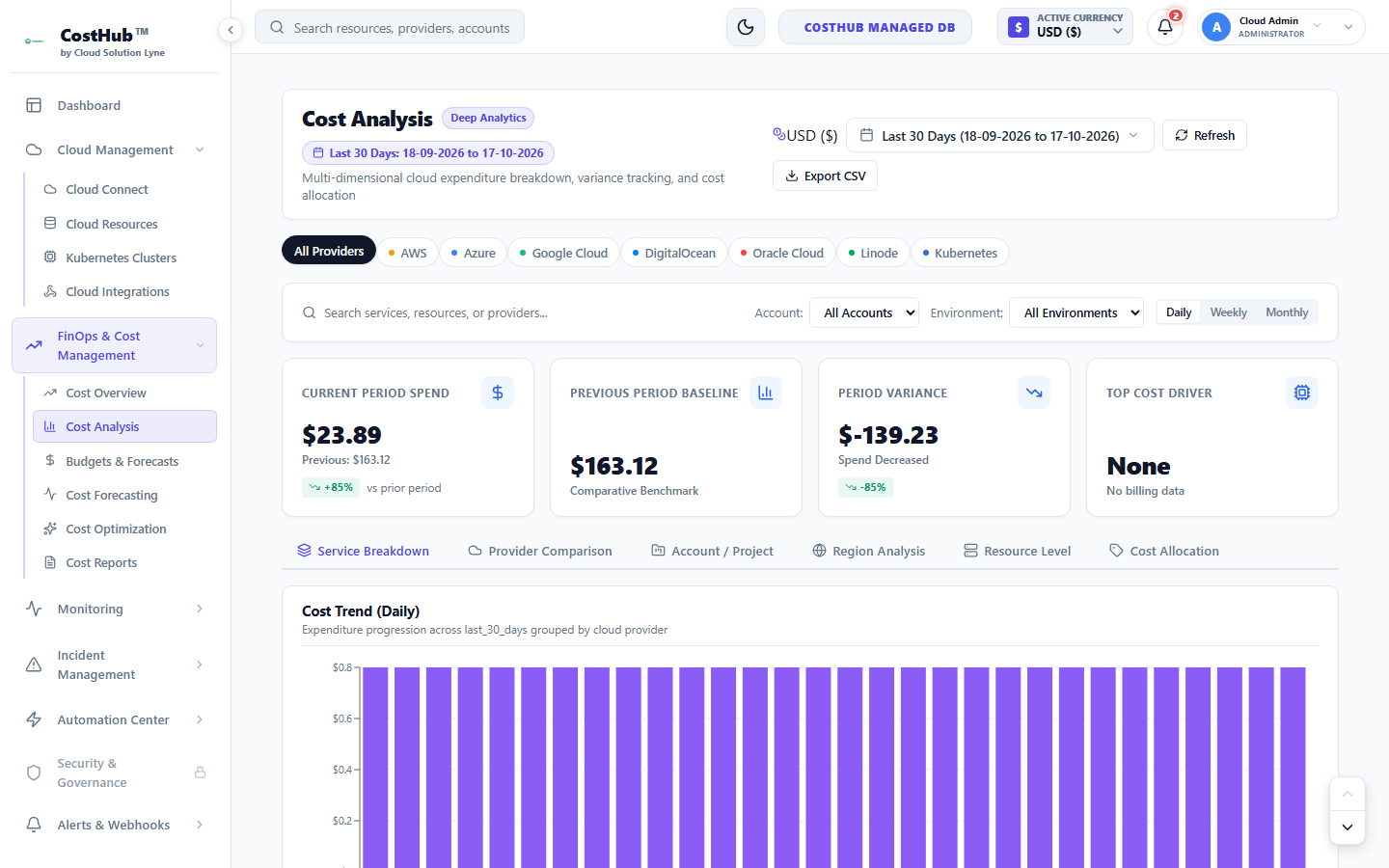
Cloud elasticity is a double-edged sword. While engineering teams can provision terabytes of RAM and hundreds of CPU cores in seconds, forgotten staging instances, unattached EBS volumes, and oversized compute instances quietly bleed capital. Effective FinOps is not about cutting infrastructure corners—it is about maximizing business value per dollar spent.
Strategy 1: Precision Workload Right-Sizing
More than 40% of provisioned cloud compute capacity operates at less than 15% peak CPU utilization. By examining 30-day P95 utilization metrics from CloudWatch or Prometheus, teams can safely downsize oversized instances (e.g. from m5.4xlarge to m5.xlarge) or transition to modern ARM64 Graviton instances delivering up to 40% better price-performance.
Strategy 2: Automated Idle Resource Reaper
Development, QA, and preview environments rarely need to run 24 hours a day, 7 days a week. Running non-production clusters only during local working hours (e.g. 8 AM to 7 PM Monday through Friday) automatically eliminates approximately 67% of non-production compute bills.
Strategy 3: Savings Plans and Reserved Instances
For baseline 24/7 production workloads, relying on on-demand hourly pricing is an expensive mistake. 1-year or 3-year Compute Savings Plans or Flexible Reserved Instances provide discounts of 35% to 72% with minimal operational risk.
Strategy 4: Intelligent Storage Lifecycle Policies
- Transition S3 Standard objects to S3 Standard-Infrequent Access (IA) after 30 days of inactivity.
- Archive historical database backups to S3 Glacier Flexible or Deep Archive after 90 days.
- Enforce automatic deletion rules on temporary build artifacts and untagged container registry images.
Strategy 5: Real-Time Anomaly Detection and Budget Gates
Monthly cloud billing surprises occur when anomalous spending runs unnoticed for weeks. Implementing automated hourly anomaly alerting via CostHub or CloudWatch allows teams to catch accidental data transfer spikes or runaway container loops within minutes rather than at month-end.
Related Topics & Cloud Technologies
Related Cloud Architecture Articles
More insights and deep dives in FinOps and Cloud Cost Optimization

Why Use Terraform for Cloud Infrastructure Automation?
Discover why Infrastructure as Code with HashiCorp Terraform is the industry benchmark for multi-cloud automation. Learn how declarative syntax, state management, modular architectures, and safe dry-run planning eliminate human error and accelerate reliable deployments across AWS, Azure, and Google Cloud.

Kubernetes Best Practices for Production Environments
Operating Kubernetes in high-scale production requires more than default manifests. Master cluster hardening, resource requests and limits, Pod Disruption Budgets, Horizontal Pod Autoscaling, network policies, and secrets encryption to achieve 99.99% workload uptime.
AWS vs Azure vs Google Cloud: Choosing the Right Platform
Evaluate AWS, Microsoft Azure, and Google Cloud Platform across compute performance, managed database capabilities, enterprise security, pricing models, and AI ecosystems. Make an informed architectural decision tailored to your organization's compliance and operational requirements.