CI/CD Pipeline Automation with Jenkins and GitHub Actions
Streamline software delivery from Git commit to production. Compare self-hosted Jenkins flexibility against modern GitHub Actions managed workflows, and learn how to construct secure, parallelized build pipelines with automated regression testing and canary releases.
Admin
Continuous Delivery Lead
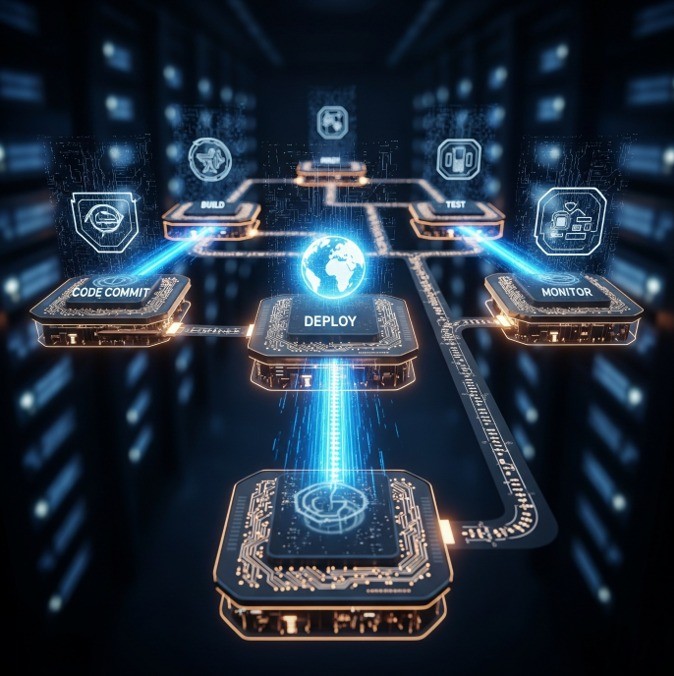
Continuous Integration and Continuous Delivery (CI/CD) pipelines form the circulatory system of modern engineering organizations. By automating compilation, unit testing, security scanning, container image packaging, and deployment, teams reduce release lead times from weeks to minutes while eliminating deployment anxieties.
Jenkins vs GitHub Actions: Architectural Trade-Offs
Jenkins offers unparalleled customization for complex internal network requirements and air-gapped on-premises setups, but requires dedicated maintenance of controller servers, build agent pools, and plugin updates. GitHub Actions integrates natively into source repositories, uses clean declarative YAML workflows, and provides managed runner pools that require zero infrastructure overhead.
Modern GitHub Actions Workflow Example
name: Production Deployment Pipeline

on:
  push:
    branches: [main]

jobs:
  test-and-lint:
    runs-on: ubuntu-latest
    steps:
      - uses: actions/checkout@v4
      - uses: actions/setup-node@v4
        with:
          node-version: '20'
          cache: 'npm'
      - run: npm ci
      - run: npm run lint
      - run: npm test -- --coverage

  build-and-push:
    needs: test-and-lint
    runs-on: ubuntu-latest
    permissions:
      id-token: write
      contents: read
    steps:
      - uses: actions/checkout@v4
      - name: Configure AWS Credentials (OIDC)
        uses: aws-actions/configure-aws-credentials@v4
        with:
          role-to-assume: arn:aws:iam::123456789012:role/github-oidc-deployer
          aws-region: us-east-1
      - name: Build & Publish Container Image
        run: |
          docker build -t app:latest .
          docker tag app:latest 123456789012.dkr.ecr.us-east-1.amazonaws.com/app:${{ github.sha }}
          docker push 123456789012.dkr.ecr.us-east-1.amazonaws.com/app:${{ github.sha }}
Best Practices for Resilient Delivery
- Passwordless Deployments: Use OIDC (OpenID Connect) authentication instead of long-lived access tokens stored in repository secrets.
- Parallel Job Execution: Run frontend linting, backend tests, and Docker builds concurrently to keep feedback loops under 5 minutes.
- Automated Rollback Triggers: Integrate APM error-rate metrics to automatically roll back releases if 5xx errors spike within 10 minutes of rollout.
Related Topics & Cloud Technologies
Related Cloud Architecture Articles
More insights and deep dives in DevOps and CI/CD
Why Use Terraform for Cloud Infrastructure Automation?
Discover why Infrastructure as Code with HashiCorp Terraform is the industry benchmark for multi-cloud automation. Learn how declarative syntax, state management, modular architectures, and safe dry-run planning eliminate human error and accelerate reliable deployments across AWS, Azure, and Google Cloud.

Kubernetes Best Practices for Production Environments
Operating Kubernetes in high-scale production requires more than default manifests. Master cluster hardening, resource requests and limits, Pod Disruption Budgets, Horizontal Pod Autoscaling, network policies, and secrets encryption to achieve 99.99% workload uptime.
5 Strategies for Cloud Cost Optimization
Uncontrolled cloud spending rapidly erodes engineering margins. Discover five battle-tested FinOps strategies: intelligent workload right-sizing, automated idle resource reclamation, commitment savings plans, storage tier lifecycles, and real-time anomaly alerting to reduce spend by 30-45%.